LoveMemo is an app for creating romantic surprises: a page with photos, a message, music and a live counter of your time together, delivered by link or QR code. It has always done well in Brazil, especially on Android, where practically every sale came from here. But iOS users pay better, and they pay even better outside Brazil.
This week I decided to tackle that. I asked Claude Code to research how to grow the app’s organic reach in other countries and which languages would be worth it. Then we applied the plan everywhere: the app, the website, the App Store and Play Store listings, keywords and screenshots. This post walks through what was done, in the order it happened.
Starting point: the sales data
Before any opinion, I opened Apple’s financial report for September, and the breakdown of sales by country surprised me. Three things stood out:
- About three quarters of iOS sales came from outside Brazil. On iOS, the international market was already the main one, and I didn’t know it.
- Spanish was already the biggest international block. Mexico, Spain, Chile, Peru and Honduras added up to about 36% of revenue, with a single listing in Spain’s Spanish and no ASO work at all.
- There were sales in English even with zero ratings on the US store.
In other words, the demand was there. People just weren’t finding the app.
Competitor research
No store shows the search volume of a keyword. The cheap way to estimate the size of a market is to look at who ranks at the top of a search and how many ratings they have in that country. Claude did this with the public iTunes search API (itunes.apple.com/search), country by country, using the terms a couple would type:
| Country | Search | Leader (ratings in that country) |
|---|---|---|
| 🇺🇸 United States | “relationship counter” | My Love — 1,048,000 |
| 🇩🇪 Germany | “paar app” | My Love — 325,000 |
| 🇰🇷 South Korea | “커플 앱” | SumOne — 132,000 |
| 🇲🇽 Mexico | “app para parejas” | noteit — 109,000 |
| 🇬🇧 United Kingdom | “couple app” | My Love — 100,000 |
| 🇧🇷 Brazil | “app casal” | Widgetable — 45,000 |
| 🇪🇸 Spain | “app para parejas” | Widgetable — 16,000 |
Ratings are not search volume, but the order of magnitude says a lot. The conclusions:
- Outside Brazil, nobody searches for “surprise”. The surprise page with a QR code is a Brazilian trend. Elsewhere, the volume is in relationship counters and couple widgets. LoveMemo has both, but the English listing was selling “surprise”.
- The US problem was ASO, not translation. The app was already in English, but it only showed up for “love surprise”, a search dominated by games.
- Germany was the biggest high-income market left unserved. A single couple counter has 325,000 ratings there alone, and there’s almost no well-translated competition.
- Japan and Korea are big, but they can wait. They’re dominated by SumOne and Between and have a very specific couple culture, with 100-day counts and “D-day”.
That turned into a plan ordered by effort and return: reposition the English listing, create listings for Mexico and the UK, and translate everything into German.
New store listings
App Store
The main change was positioning. In English, the app stopped being “a surprise” and became “a couple days counter with a widget”, with the surprise as the differentiator.
| Listing | Before | After |
|---|---|---|
| en-US | LoveMemo - Surprise your love · Couple widgets & surprises | LoveMemo: Couple Days Counter · Relationship widget & gift |
| es | LoveMemo - Sorprende tu pareja · Widgets y sorpresas de pareja | LoveMemo: Contador de Pareja · Widget de amor y aniversario |
| de-DE | — | LoveMemo: Paar App & Zähler · Beziehung, Jahrestag, Widget |
The keywords were redone too. In English, weak terms like 365day, inlove and qr code were dropped in favor of together, anniversary, boyfriend, girlfriend, tracker and friends, without repeating what’s already in the name and subtitle (Apple already indexes those fields).
Two new listings had a less obvious reason:
- es-MX. According to tests by AppTweak and Mobile Action, the US store also indexes the keywords from the Mexican Spanish listing, but not the ones from Spain. So
es-MXwins Mexico, already the #2 country in sales, and adds another 100 characters of keywords that count in the US. I used some of them for English terms that didn’t fit inen-US, likepartnerandhusband. Worth noting: this comes from third-party tests, not from Apple’s documentation. - en-GB. Without it, the UK and Australia get the US listing. With its own listing, a different set of keywords comes in (
valentines,memories) without losing the US terms.
One detail that cost some time: on iOS, the name, subtitle, keywords and new languages can only be edited on a new app version. So all of it went into 1.6.1, created straight in App Store Connect by Claude using the asc CLI, along with the release notes in every language. All I did was upload the build.
Play Store
On the Play Store, listings change without a new build, so it was faster. The same repositioning went into the English and Spanish listings, and new listings were created for the UK (en-GB), Latin America (es-419) and Germany (de-DE):
| Listing | Title | Short description |
|---|---|---|
| en-US / en-GB | LoveMemo: Couple Days Counter | Relationship counter & couple widget. Count your days together and surprise them |
| es-419 | LoveMemo: Contador de Pareja | Contador de pareja y widget de novios. Cuenten sus días juntos y sorprende |
| de-DE | LoveMemo: Paar App & Zähler | Beziehungszähler & Paar-Widget: Zähl eure gemeinsamen Tage und überrasche! |
The Portuguese listing stayed as it was. In Brazil, the surprise is the product, and the app already ranks first for “surpresa para namorado” (“surprise for boyfriend”).
All the listing copy lives in the repository, as JSON and in fastlane’s format, and is pushed from the command line. That matters: you can review it in a diff, version it and redo it in another language without opening a single dashboard.
German in the app, the website and the surprise page
Translating only the listing is pointless if the app opens in English. German went in everywhere: the app’s ~550 strings, the Android widget, dates, the website and the page the recipient opens when they scan the QR code, including the share image and text.
The translation was done by AI and shipped without a review by a native speaker. That was a deliberate call: I’d rather get German live now and fix it based on feedback from real users than stall the plan waiting for a reviewer. If you speak German and something reads oddly, let me know.
Different screenshots for each market
The first three screenshots show up in search results and drive a big share of downloads. If abroad people search for widgets and counters, the images need to open with the widget and the counter. In Brazil, they open with the surprise.
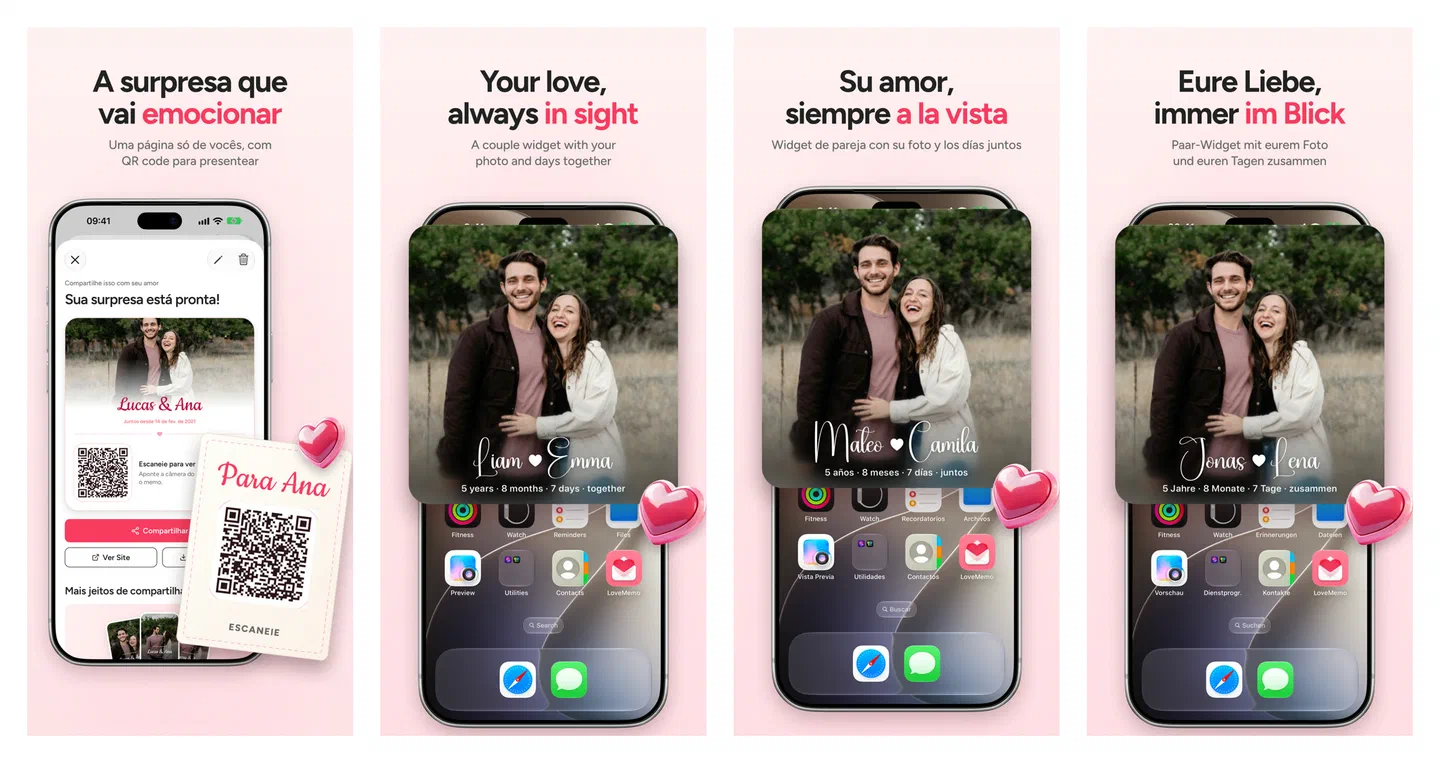
The order of the seven frames changes per language:
| Language | Order |
|---|---|
| pt | surprise, styles, counter, recap, widget, cards, occasions |
| en, de | widget, counter, recap, styles, gift, cards, occasions |
| es | widget, counter, gift, styles, recap, cards, occasions |
In Spanish the gift moves up, because “regalo” carries weight in searches there. The captions also carry each market’s keywords (couple widget, contador de pareja, Beziehungszähler), since Apple reads the text in screenshots.
The first version was correct, but bland. We redid it following the principles in The Indie Developer’s Guide to App Store Screenshots: one frame, one idea; show the result, not the form; a different layout per frame; real photos of a couple; no third-party brands, prices or “#1”. And no ratings frame, because there are no ratings to show yet.
None of this was done by hand in Figma. Claude took the captures in the iOS simulator and in a headless browser, and a script composes the final images at App Store and Play Store sizes, with each language’s captions and order coming from a JSON file. That paid off two days later: the app got a redesign, and every screenshot, in four languages and two stores, was redone in one afternoon, along with the App Store header and search result images.
A new website, with one landing page per language
The LoveMemo website was a React app rendered in the browser. It became static HTML generated with Hugo, like this site, with a title, description, hreflang and structured data per page in all four languages.
And each language got its own landing page, not a translation of the same page:
| Language | Title for Google | Opens with |
|---|---|---|
| pt | Site de Surpresa para Namorado(a) com QR Code | the QR code surprise |
| en | Romantic Surprise Website & Relationship Counter | the gift, with the counter right after |
| es | Regalo Original para tu Pareja con Fotos y Canción | the gift and the song, with the counter right after |
| de | Beziehungszähler, Paar-Widget & Jahrestag-Geschenk | the counter (“Jeder Tag mit dir zählt”) |
The German version also got a privacy section, explaining that the surprise isn’t public, that there are no ads or data sales and that you can delete everything whenever you want. In Germany, that weighs on the decision.
We also rewrote the Terms of Use and Privacy Policy from what the app and the API actually do. The old text came from a generator and mentioned SDKs the app doesn’t even use. An llms.txt and Markdown versions of the pages went in too, so the app shows up properly when someone asks ChatGPT or Perplexity about gifts for their partner.
Finally, two pieces for organic traffic from Google: a relationship time calculator, which answers the “how long have we been together” search and leads to the app, and a blog with a content plan per language. The first post, about long-distance relationships, went out today.
Early results
The Play Store listings went live on the 19th. A few days later, results started to show: Android, which used to sell almost only in Brazil, started selling in other countries. On iOS, the changes shipped with versions 1.6.1 and 1.7.0, and the effect is just getting started.
What I’m taking from this (so far)
- Look at the data before translating. I was going to start by translating the app into a new language. The data showed the bigger problem was English, which already existed and didn’t rank.
- The same product sells differently in each country. In Brazil, LoveMemo is a surprise. Abroad, it’s a couple counter that also becomes a gift. The app is the same; what changes is what comes first in the listing, the screenshots and the website.
- Everything as code. Listings, keywords and screenshots in the repository, published from the command line. That turns “redo everything in four languages” from a week of work into an afternoon.
- AI did the heavy lifting, but the direction was a conversation. The research, the listing copy, the translations and the scripts came out of Claude Code. The decisions, like leaving Portuguese as it was, redoing the bland screenshots or shipping German without waiting for a review, came from discussing the results, as I wrote in the previous post.
This post isn’t a surefire tutorial on what to do. It’s just one part of my journey with LoveMemo, and some of these bets probably won’t pay off. I’ll keep posting the hits and misses here, and once I have enough data, I’ll look at what worked and what didn’t.